Anyrow vs Skene
Side-by-side comparison to help you choose the right product.

Anyrow instantly extracts structured, editable data from PDFs and documents using AI.
Last updated: April 13, 2026

Skene turns your codebase into AI-driven growth prompts you own and control.
Last updated: February 28, 2026
Visual Comparison
Anyrow

Skene
Feature Comparison
Anyrow
Schema-Driven AI Extraction
Ditch per-vendor templates forever. Define your data columns once—like "vendor," "invoice number," "amount," "due date"—and Anyrow's AI does the heavy lifting. It intelligently maps and extracts those specific fields from any document layout, whether it's a native PDF, a scanned image, or a camera photo. This adaptive approach handles format variations automatically, delivering consistent, structured rows with high confidence, typically in just over a second.
Live Editable Tables with Built-in Storage
Extracted data flows instantly into real-time, collaborative tables within Anyrow. This isn't just an export preview; it's a fully functional structured database. Your team can immediately review, sort, filter, edit, and correct data without switching apps. It provides a single source of truth for your extracted data, combining the extraction engine with a powerful storage and collaboration layer so you can manage everything in one place.
Multi-Format Export & Native Integrations
Get your clean data into any downstream system effortlessly. Export directly to common formats like CSV and Excel (XLSX) or JSON for developers. For automated pipelines, use the robust REST API, the convenient TypeScript SDK, or configure real-time webhooks. Anyrow is built to connect, ensuring the data you extract can instantly power your accounting software, ERP, spreadsheets, or custom applications.
Batch Processing & High-Volume Handling
Upload hundreds of documents at once for rapid, bulk processing. Anyrow is engineered for volume, enabling ops and finance teams to process large batches of invoices, receipts, or shipping documents in minutes instead of days. This batch capability, combined with per-document speeds of around 1.4 seconds, transforms back-office data entry from a days-long bottleneck into a swift, automated task.
Skene
Codebase-Native Signal Detection
Skene connects directly to your GitHub or GitLab repository with read-only access, analyzing your codebase to automatically detect growth signals, user friction points, and activation opportunities. It understands your product's structure and user flows at the code level, eliminating the need for manual instrumentation or external tracking scripts. This provides a deep, contextual understanding of how users interact with your core product.
Autonomous Growth Loop Engine
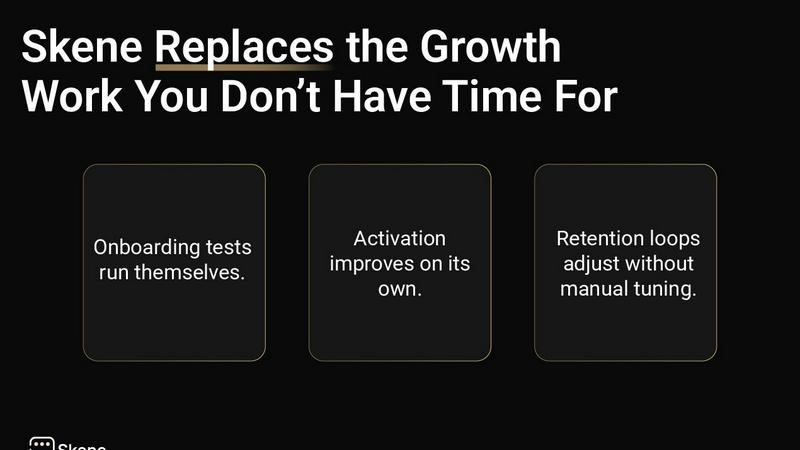
The platform acts as a fully automated iteration engine. It doesn't just identify problems; it autonomously creates, tests, and deploys optimized versions of user flows for onboarding, activation, and retention. Your product's growth mechanisms continuously improve themselves based on real user data, turning your product into a self-optimizing growth engine without manual intervention from a dedicated team.
Prompt-Driven Growth Infrastructure
Growth starts with a single prompt. Skene provides a context layer for your AI, allowing you or your AI agent to command growth implementations directly from your IDE or terminal. You can analyze, audit, and implement changes through natural language prompts, making growth a programmable and version-controlled part of your development workflow, just like any other feature.
Owned & Version-Controlled Stack
Replace fragile third-party widgets and black-box scripts with code you own. Skene integrates growth directly into your tech stack, allowing you to version, prompt, and control all growth logic. This eliminates performance bottlenecks from external snippets, prevents data siloing, and ensures your growth infrastructure is as robust and maintainable as the rest of your application.
Use Cases
Anyrow
Accounts Payable & Invoice Processing
Automate the entire invoice-to-ledger workflow. Upload batches of supplier invoices in any format. Anyrow extracts key data like vendor details, invoice numbers, amounts, and due dates into structured rows. The finance team can quickly review, approve, and edit within the platform before exporting the clean data directly into their accounting software or ERP, slashing processing time and manual errors.
Receipt & Expense Management
Streamline expense reporting for employees or clients. Staff simply photograph or forward receipt emails. Anyrow extracts merchant names, dates, totals, and tax amounts, populating a centralized, audit-ready table. Bookkeepers can then easily categorize expenses, resolve discrepancies, and export finalized reports for reimbursement or client billing in a fraction of the usual time.
Logistics & Shipping Document Processing
Parse bills of lading, packing slips, and delivery notes at scale. Dispatchers and logistics coordinators upload documents to automatically extract critical data like PO numbers, shipment IDs, weights, and destinations. This data feeds directly into tracking systems and freight audits, providing real-time visibility and eliminating manual data entry from chaotic paper trails.
Client Onboarding & Document Intake
Accelerate KYC (Know Your Customer) and client onboarding for accounting firms or financial services. Upload identification documents, bank statements, and application forms. Anyrow pulls out structured client data (names, addresses, account numbers), organizing it into neat, searchable tables. This reduces manual data scrubbing, speeds up setup, and improves data accuracy for new client profiles.
Skene
Automated Onboarding Flow Optimization
For teams drowning in manual tour creation and maintenance, Skene automatically generates and iterates onboarding flows by analyzing user behavior in your code. It identifies where users drop off and autonomously deploys better guidance, slashing time-to-value and boosting activation rates without a single line of manual tour code.
Self-Healing Customer Journeys
Stop worrying about UI overlays breaking after every deploy. Skene's code-native approach means all onboarding and lifecycle automation updates itself when you push new code. It continuously audits the user journey against your latest codebase, ensuring guidance and growth loops are always in sync with your live product.
Indie Hacker & Startup Scaling
Indie developers and early-stage startups can implement sophisticated, data-driven PLG strategies without a growth team. Skene acts as your "growth team in a box," enabling you to compete with larger players by systematically tightening activation funnels and improving retention, all while conserving critical resources and headcount.
AI-Agent Driven Development
Integrate growth directly into your AI-powered development workflow. Your AI agent can use Skene's context layer to analyze the codebase for growth opportunities and execute prompt-driven implementations. This allows for fully automated, intelligent iteration cycles where your AI assistant can directly ship growth improvements.
Overview
About Anyrow
Anyrow is the AI-powered document extraction engine that turns unstructured chaos into structured data in seconds. It's built for ops teams, bookkeepers, accounting firms, logistics dispatchers, and finance professionals who are tired of the manual grind and the tech stack sprawl. The core value proposition is stunningly simple: drop any document—PDFs, scans, invoices, receipts, emails, Word files, Excel sheets, or images—and get back clean, editable rows in a live table. Anyrow eliminates the need for fragile, per-vendor templates. Instead, you define your data schema (the columns you need) once. Its schema-driven AI then intelligently finds and extracts those specific fields across any document layout, whether it's a native digital PDF, a scanned document, or a photographed receipt. The platform consolidates your entire workflow: extraction, structured storage, review, editing, and querying all happen in one login. Then, push your production-ready data out via CSV, XLSX, JSON, REST API, TypeScript SDK, or webhooks. Anyrow is designed to replace the cumbersome patchwork of tools like Parseur (extraction), Airtable (storage), and Zapier (automation), delivering extraction, storage, CRUD operations, and API access in a single, agile product.
About Skene
Skene is the AI-powered PLG (Product-Led Growth) infrastructure that transforms how products scale. It's a fully automated iteration engine designed to drive user growth without the need for a dedicated growth team. By connecting directly to your codebase and IDE, Skene observes real user actions to detect friction points and activation drop-offs. It then autonomously creates, tests, and deploys optimized versions of user flows for onboarding, activation, and retention. This means your product's growth mechanisms improve themselves continuously, based on a deep understanding of your actual customer code. Built for indie developers, early-stage startups, and established PLG companies, Skene acts as a "growth team in a box." It allows builders to offload growth work, tighten activation funnels, and expand customer lifetime value—all without adding headcount or managing brittle, third-party widgets. Its core promise is to make growth a native, ownable part of your tech stack that you can version, prompt, and control, ending reliance on external black-box scripts.
Frequently Asked Questions
Anyrow FAQ
What types of documents can Anyrow process?
Anyrow is built for document diversity. It can process native digital PDFs, scanned PDFs, images (JPEG, PNG), photographs of documents, Microsoft Word files, Excel spreadsheets, and even text extracted from emails. The AI is trained to handle structured, semi-structured, and unstructured layouts commonly found in invoices, receipts, forms, and reports.
How accurate is the AI extraction?
The AI delivers high accuracy, typically demonstrating 99%+ confidence on well-formed documents, as noted in the provided example. Accuracy is maintained across various layouts because the system uses your defined schema to target specific fields, rather than relying on rigid templates. Any extracted data is instantly available for human review and editing within the live tables to ensure 100% correctness before export.
Do I need to create a template for every vendor or document type?
No. This is the core innovation of Anyrow. You do not create per-vendor or per-document-type templates. Instead, you define a single schema for your project—the set of columns you need (e.g., Invoice Date, Amount, Vendor). The AI uses this schema to find and extract the corresponding data from any document you upload, regardless of its visual layout or source.
How do I get my data out of Anyrow?
You have multiple robust options. For manual downloads, you can export your tables directly to CSV or Excel (XLSX) format. For developers and automated workflows, you can export as JSON, use the comprehensive REST API for programmatic access, utilize the TypeScript SDK, or configure webhooks to push data to other apps in real-time. Anyrow is designed to fit seamlessly into your existing data stack.
Skene FAQ
How is Skene different from traditional customer experience software?
Traditional tools require manual tour creation, constant maintenance, and rely on brittle UI overlays that break with every deploy. Skene is fundamentally different; it reads your codebase and automatically generates onboarding, analytics, and lifecycle automation. When you push code, Skene's systems update themselves, eliminating maintenance overhead and fragility.
How long does it take to set up?
Setup takes less than 60 seconds. You simply connect your GitHub or GitLab repository (read-only access is sufficient), and Skene automatically analyzes your codebase to generate PLG flows. No initial code changes, API modifications, or complex configuration is required to get started.
Is my code secure?
Absolutely. Security is a core principle. Skene only requires read-only access to your repository. All analysis happens in a secure, isolated environment. We do not store your source code, and the system is designed to respect your intellectual property and privacy at all times.
What kind of analytics do you provide?
Skene's dashboard provides real-time analytics on user progress, completion rates, and engagement metrics. It focuses on outcome-based insights like time-to-value and bottleneck identification, allowing you to measure the direct impact of optimizations and make data-driven decisions to improve your product-led growth loops.
Alternatives
Anyrow Alternatives
Anyrow is an AI-powered document extraction and structured data platform. It automates the tedious process of pulling data from PDFs, invoices, emails, and scans into clean, editable tables. This places it squarely in the categories of AI automation and productivity software, designed to eliminate manual data entry. Users often explore alternatives for several key reasons. Budget constraints, specific feature requirements like advanced OCR or native integrations, and the need for a different deployment model (like on-premise) can drive the search. Some teams may already have parts of the stack in place and seek a more modular tool. When evaluating options, focus on core capabilities. Look for robust AI that handles diverse layouts without per-template setup, built-in data storage and management, and flexible export and API access. The goal is to find a solution that truly consolidates your workflow, saving time and reducing the complexity of using multiple disconnected apps.
Skene Alternatives
Skene is an AI-powered PLG infrastructure that automates product-led growth by turning your codebase into a self-optimizing engine. It belongs to the productivity and management category, specifically designed for developers and product teams who want to scale user growth autonomously. Users often explore alternatives for several reasons. These include budget constraints, specific feature needs not covered, or a preference for a different implementation model, such as manual control over fully autonomous systems. Platform compatibility and the desire for more traditional analytics versus AI-driven action are also common drivers. When evaluating options, focus on core capabilities. Look for solutions that deeply integrate with your development workflow, offer actionable insights beyond basic analytics, and provide clear ownership of the growth logic. The ideal tool should align with your team's technical stack and capacity, whether you need full automation or a more hands-on, collaborative approach.