Skene vs Tickari
Side-by-side comparison to help you choose the right product.

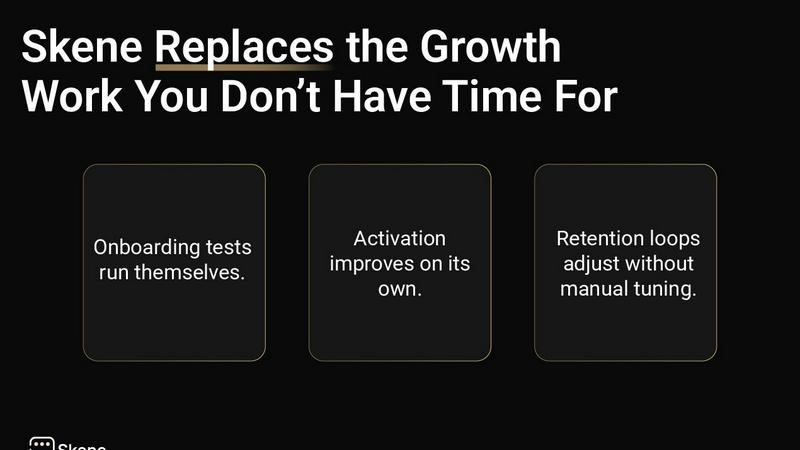
Skene turns your codebase into AI-driven growth prompts you own and control.
Last updated: February 28, 2026

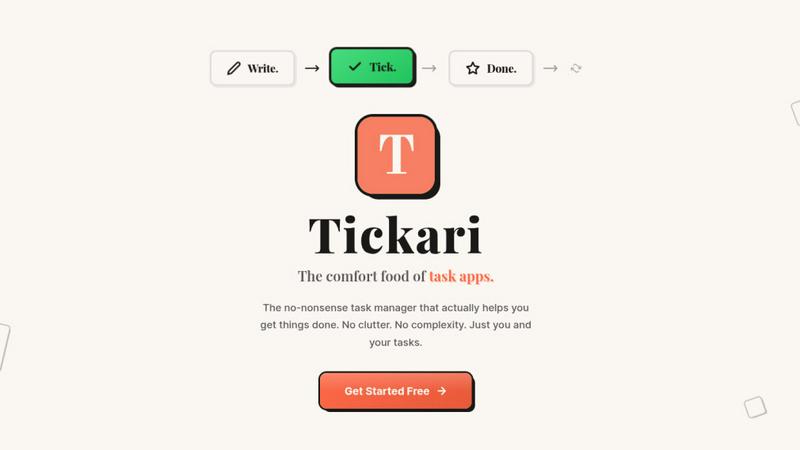
Tickari is the no-nonsense task manager that cuts the clutter so you can finally start doing.
Last updated: April 13, 2026
Visual Comparison
Skene
Tickari
Feature Comparison
Skene
Codebase-Native Signal Detection
Skene connects directly to your GitHub or GitLab repository with read-only access, analyzing your codebase to automatically detect growth signals, user friction points, and activation opportunities. It understands your product's structure and user flows at the code level, eliminating the need for manual instrumentation or external tracking scripts. This provides a deep, contextual understanding of how users interact with your core product.
Autonomous Growth Loop Engine
The platform acts as a fully automated iteration engine. It doesn't just identify problems; it autonomously creates, tests, and deploys optimized versions of user flows for onboarding, activation, and retention. Your product's growth mechanisms continuously improve themselves based on real user data, turning your product into a self-optimizing growth engine without manual intervention from a dedicated team.
Prompt-Driven Growth Infrastructure
Growth starts with a single prompt. Skene provides a context layer for your AI, allowing you or your AI agent to command growth implementations directly from your IDE or terminal. You can analyze, audit, and implement changes through natural language prompts, making growth a programmable and version-controlled part of your development workflow, just like any other feature.
Owned & Version-Controlled Stack
Replace fragile third-party widgets and black-box scripts with code you own. Skene integrates growth directly into your tech stack, allowing you to version, prompt, and control all growth logic. This eliminates performance bottlenecks from external snippets, prevents data siloing, and ensures your growth infrastructure is as robust and maintainable as the rest of your application.
Tickari
Zero-Friction Interface
The moment you open Tickari, you are working. There is no onboarding flow, no account setup barrier, and no complex dashboard to decipher. The interface presents a clean, focused space where your only options are to add a task or check one off. This elimination of initial friction ensures you spend zero time configuring the tool and 100% of your time on the tasks that matter, making it the fastest way to go from thought to action.
Deliberate Feature Minimalism
Tickari is defined by what it doesn't have. You won't find tags, priority flags, complex project boards, AI assistants, or color-coded calendars. This intentional constraint is a feature in itself. By removing the endless decisions that come with feature-rich apps—"Should I tag this? What priority is it? Which board does it go in?"—Tickari eliminates decision fatigue and cognitive clutter, allowing you to focus solely on the next actionable item.
Instant Task Capture & Completion
The core workflow is engineered for speed. Adding a task is as simple as typing and hitting enter. Completing a task is a single, satisfying click. This rapid capture-and-completion cycle creates a powerful momentum, turning your to-do list from a stagnant inventory into a dynamic flow of progress. It turns task management from a chore into a quick, rewarding habit.
The "Tickari Pro" Personal Hub
For users who want to share their public notes or tasks, Tickari Pro offers a personalized corner of the internet. It provides a custom subdomain (like yourname.tickari.com) where you can host a clean, minimalist profile page to share lists or notes with the world. This extends the simple philosophy to public sharing, without adding complexity to the core private task management experience.
Use Cases
Skene
Automated Onboarding Flow Optimization
For teams drowning in manual tour creation and maintenance, Skene automatically generates and iterates onboarding flows by analyzing user behavior in your code. It identifies where users drop off and autonomously deploys better guidance, slashing time-to-value and boosting activation rates without a single line of manual tour code.
Self-Healing Customer Journeys
Stop worrying about UI overlays breaking after every deploy. Skene's code-native approach means all onboarding and lifecycle automation updates itself when you push new code. It continuously audits the user journey against your latest codebase, ensuring guidance and growth loops are always in sync with your live product.
Indie Hacker & Startup Scaling
Indie developers and early-stage startups can implement sophisticated, data-driven PLG strategies without a growth team. Skene acts as your "growth team in a box," enabling you to compete with larger players by systematically tightening activation funnels and improving retention, all while conserving critical resources and headcount.
AI-Agent Driven Development
Integrate growth directly into your AI-powered development workflow. Your AI agent can use Skene's context layer to analyze the codebase for growth opportunities and execute prompt-driven implementations. This allows for fully automated, intelligent iteration cycles where your AI assistant can directly ship growth improvements.
Tickari
Beating Procrastination & Overwhelm
When a big project feels paralyzing, breaking it down in a complex tool can become its own form of avoidance. Tickari cuts through that. Quickly dump the first three small, actionable steps into the list. The simplicity makes starting less daunting, and the act of ticking off those first few items builds immediate momentum to tackle larger pieces, breaking the cycle of procrastination.
Daily Personal Task Juggling
For managing the daily flood of personal errands, home admin, and quick reminders, you don't need a project management suite. Tickari is the perfect digital scratchpad. Jot down "call vet," "pick up dry cleaning," and "pay electricity bill" in seconds. The uncluttered view keeps these tasks top-of-mind, and checking them off provides a clear, satisfying record of your daily accomplishments.
Meeting & Lecture Note Action Items
During meetings or lectures, you often need to capture quick follow-ups without getting distracted by software. With Tickari open in a browser tab, you can instantly capture action items like "email Sarah the report" or "research topic X" as they come up. After the session, you have a clean, focused list of exactly what needs to be done next, with no extraneous notes to sort through.
Creative Project Focus
Writers, developers, and artists often need to manage a pipeline of creative tasks without the tool itself becoming a distraction. Tickari allows them to list out discrete creative actions—"sketch concept A," "write chapter 3 intro," "debug login function"—in a serene, minimalist environment. This keeps the focus on the creative work itself, not on organizing or categorizing it.
Overview
About Skene
Skene is the AI-powered PLG (Product-Led Growth) infrastructure that transforms how products scale. It's a fully automated iteration engine designed to drive user growth without the need for a dedicated growth team. By connecting directly to your codebase and IDE, Skene observes real user actions to detect friction points and activation drop-offs. It then autonomously creates, tests, and deploys optimized versions of user flows for onboarding, activation, and retention. This means your product's growth mechanisms improve themselves continuously, based on a deep understanding of your actual customer code. Built for indie developers, early-stage startups, and established PLG companies, Skene acts as a "growth team in a box." It allows builders to offload growth work, tighten activation funnels, and expand customer lifetime value—all without adding headcount or managing brittle, third-party widgets. Its core promise is to make growth a native, ownable part of your tech stack that you can version, prompt, and control, ending reliance on external black-box scripts.
About Tickari
Tickari is the antidote to productivity bloat. It's a deliberately minimal, no-nonsense task manager built for a specific type of person: the doer who is tired of organizing and just wants to execute. In a world saturated with complex kanban boards, AI-powered suggestions, and endless customization options that promise productivity but deliver procrastination, Tickari takes a radical stand. Its philosophy is "less but better." It strips away every ounce of friction, clutter, and cognitive overhead to deliver a pure, instant workflow: write a task, tick it off, and move on. There is no setup, no tutorial, and no learning curve. The interface is clean, intuitive, and works the second you open it. Tickari is for the professional, student, or creator who feels stuck in the meta-work of managing their tools instead of completing their actual work. It's the comfort food of task apps—reliable, satisfying, and without any unnecessary garnish. Its core value proposition is ruthless simplicity that translates directly into action, helping you stop planning and start doing.
Frequently Asked Questions
Skene FAQ
How is Skene different from traditional customer experience software?
Traditional tools require manual tour creation, constant maintenance, and rely on brittle UI overlays that break with every deploy. Skene is fundamentally different; it reads your codebase and automatically generates onboarding, analytics, and lifecycle automation. When you push code, Skene's systems update themselves, eliminating maintenance overhead and fragility.
How long does it take to set up?
Setup takes less than 60 seconds. You simply connect your GitHub or GitLab repository (read-only access is sufficient), and Skene automatically analyzes your codebase to generate PLG flows. No initial code changes, API modifications, or complex configuration is required to get started.
Is my code secure?
Absolutely. Security is a core principle. Skene only requires read-only access to your repository. All analysis happens in a secure, isolated environment. We do not store your source code, and the system is designed to respect your intellectual property and privacy at all times.
What kind of analytics do you provide?
Skene's dashboard provides real-time analytics on user progress, completion rates, and engagement metrics. It focuses on outcome-based insights like time-to-value and bottleneck identification, allowing you to measure the direct impact of optimizations and make data-driven decisions to improve your product-led growth loops.
Tickari FAQ
Is there really no onboarding or account needed?
Yes, that's correct. You can start using Tickari's core task management functionality instantly without creating an account, providing an email, or going through any tutorial. This is central to its frictionless design. For Pro features like a custom subdomain, an account is required, but the free experience is designed to be immediate and barrier-free.
How does Tickari handle projects or due dates?
It doesn't, by design. Tickari operates on the principle that adding layers like due dates and project categories often becomes a form of procrastination. The goal is to present a single, flat list of your most immediate priorities. For complex project planning, it's recommended to use a separate, more specialized tool. Tickari excels at the "doing" phase once your plan is set.
Can I access my tasks on multiple devices?
The provided context focuses on the web-based experience and its instant access. For seamless multi-device syncing, a user account would typically be required. The free, instant-use version is likely optimized for simplicity and may prioritize session-based use on a single browser, while Pro likely enables synced access across devices.
What's the difference between the free and Pro version?
The free version offers the complete, no-nonsense core task manager with instant access. Tickari Pro adds the ability to create a public, personalized profile page on a custom subdomain (e.g., yourname.tickari.com). This is for users who want to share lists or notes with others in the same clean, minimalist format, without adding any complexity to the private task management interface.
Alternatives
Skene Alternatives
Skene is an AI-powered PLG infrastructure that automates product-led growth by turning your codebase into a self-optimizing engine. It belongs to the productivity and management category, specifically designed for developers and product teams who want to scale user growth autonomously. Users often explore alternatives for several reasons. These include budget constraints, specific feature needs not covered, or a preference for a different implementation model, such as manual control over fully autonomous systems. Platform compatibility and the desire for more traditional analytics versus AI-driven action are also common drivers. When evaluating options, focus on core capabilities. Look for solutions that deeply integrate with your development workflow, offer actionable insights beyond basic analytics, and provide clear ownership of the growth logic. The ideal tool should align with your team's technical stack and capacity, whether you need full automation or a more hands-on, collaborative approach.
Tickari Alternatives
Tickari is a minimalist task manager in the productivity software category, built for those who want to cut through the noise and focus purely on execution. Its philosophy is one of radical simplicity, stripping away every non-essential feature to leave only a clean, immediate interface for listing and completing tasks. Users often explore alternatives for various practical reasons. Some may require more advanced capabilities like team collaboration, project timelines, or deep integrations. Others might have specific budget constraints, need a different platform like a dedicated desktop app, or simply prefer a different visual approach to task management. When evaluating other options, consider your true needs versus wants. Look for a tool that aligns with your workflow without adding unnecessary steps. The best alternative minimizes the gap between your intention to do work and actually doing it, ensuring you spend less time managing tasks and more time completing them.