
act101
act101 is a lightning-fast Rust binary that lets AI agents instantly refactor and port code across 163 languages with zero setup or data leaks.
Visit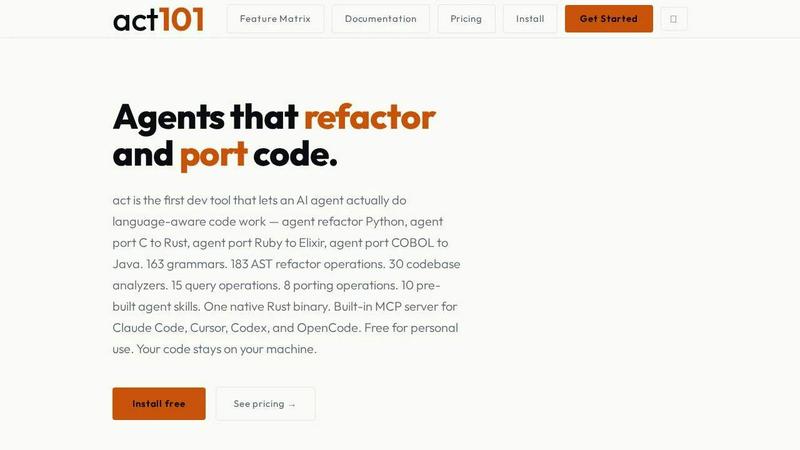
About act101
act101 is a groundbreaking developer tool that finally gives AI coding agents the ability to perform real, language-aware code refactoring and porting across an astonishing 163 programming languages. Built as a native Rust binary with a built-in Model Context Protocol (MCP) server, act101 exposes over 183 AST-aware refactor operations, 30 codebase analyzers, 15 query operations, and 8 porting operations directly to AI agents like Claude Code, Cursor, Codex, and OpenCode. This means your AI agent can now actually extract functions, rename symbols across entire workspaces, convert Python to dataclasses, port C code to Rust, or migrate Ruby to Elixir with surgical precision instead of sloppy whole-file rewrites. Every operation is AST-aware, preserving comments, formatting, and cross-file consistency while providing automatic checkpointing and instant undo. Your code never leaves your machine, there is no indexing or caching, and the single binary eliminates plugin runtimes and supply chain risks. For developers and teams who want their AI agents to stop chatting about refactoring and start doing it, act101 delivers the first tool that makes language-aware code work a reality.
Features of act101
183 AST Refactor Operations for AI Agents
act101 provides a massive library of 183 typed, AST-aware refactor operations that your AI agent can call directly. These include extract-function, rename, move-symbol, inline, convert-to-dataclass, extract-trait, add-type-hints, organize-imports, generate-init, and 174 more. Each operation understands the syntax tree of the target language, ensuring that changes are precise, consistent across files, and preserve comments and formatting. Automatic checkpointing on every operation means the agent can instantly undo any change that looks wrong, giving you complete control over the refactoring process.
8 Porting Operations for Cross-Language Migration
act101 introduces a state machine approach to language porting with eight dedicated operations: port_contract anchors the source-to-target migration, port_inventory enumerates every symbol that must move, port_order resolves dependency ordering, and a port_manifest state machine (init, add, update, remove, note) tracks progress step by step. This works between any two of the 163 supported grammars, enabling AI agents to port C to Rust, Ruby to Elixir, COBOL to Java, or any other combination with structured, traceable progress.
30 Codebase Analyzers for Deep Structural Insight
Before your AI agent touches a single line of code, act101 equips it with 30 powerful codebase analyzers. These include cohesion analysis, coupling detection, cycle identification, chokepoint discovery, hotspot mapping, dead code detection, layer analysis, seam identification, cluster analysis, surface analysis, fan balance, migration readiness, and type completeness. The agent gets a complete structural map of the repository, enabling informed decisions about where to refactor, what to port, and how to prioritize changes.
10 Pre-Built Agent Skills for Common Workflows
act101 ships with 10 pre-built agent skills that compose its operations into ready-to-use engineering workflows. These skills include architecture-audit, code-review, refactoring, code-navigation, code-generation, migration-assessment, boundary-analysis, change-impact, health-check, and architectural-refactoring. Developers invoke them with simple commands like /skill-name in Claude Code, Cursor, or other MCP-aware clients, instantly activating complex multi-step processes without manual orchestration.
Use Cases of act101
Large-Scale Code Refactoring Across Multiple Languages
When a development team needs to extract repeated logic into shared functions across a monorepo containing Python, TypeScript, and Go services, act101 enables the AI agent to call extract-function, rename, and move-symbol operations across all three languages with AST precision. The agent can identify duplicate code patterns, extract them into reusable modules, update all imports and references automatically, and checkpoint every change for instant rollback. This reduces a week-long manual refactoring effort to minutes of agent-guided work.
Cross-Language Porting for Legacy Modernization
A company maintaining a legacy COBOL system needs to port critical business logic to Java for cloud deployment. act101 allows the AI agent to use port_contract to define the migration scope, port_inventory to enumerate every COBOL symbol that must move, port_order to resolve dependencies, and the port_manifest state machine to track progress. The agent systematically translates each function, data structure, and business rule while maintaining the original logic and producing Java code that follows modern conventions.
Codebase Health Audits Before Major Changes
Before a team begins a major architectural overhaul, act101 enables the AI agent to run the architecture-audit skill, which composes multiple analyzers to evaluate coupling, cycles, dead code, hotspots, and boundary integrity. The agent produces a detailed report identifying problematic modules, circular dependencies, and migration readiness scores. This gives the team a data-driven roadmap for where to focus refactoring efforts and which areas are safe to modify.
Automated Code Review with Structural Analysis
During a code review process, act101 allows the AI agent to invoke the code-review skill, which analyzes the changed code against the full codebase. The agent checks for introduced coupling, new cycles, dead code, and boundary violations. It can suggest refactoring operations like extract-function for overly complex methods or convert-to-dataclass for data-heavy classes. The reviewer gets actionable, AST-aware recommendations rather than generic style comments.
Frequently Asked Questions
How does act101 keep my code secure and private?
act101 runs entirely on your local machine as a native Rust binary. Your code never leaves your computer, and there is no telemetry or data collection. The only external communication is license verification, which may contact our servers. There is no indexing, caching, or cold start, so your code is never stored or transmitted anywhere. The single binary design eliminates plugin runtimes and supply chain attack surfaces.
Which AI coding agents and tools are compatible with act101?
act101 is MCP-native, meaning it works with any Model Context Protocol-aware client. This includes Claude Code, Cursor, Windsurf, Codex, OpenCode, and any other MCP-compatible agent. The built-in MCP server exposes all 183 refactor operations, 30 analyzers, 15 queries, 8 porting operations, and 10 pre-built skills directly to these agents. Setup is straightforward and documented.
What languages does act101 support for refactoring and porting?
act101 supports 163 programming language grammars in a single binary. This covers virtually every mainstream language including Python, Rust, TypeScript, JavaScript, Go, Java, C, C++, Ruby, Elixir, COBOL, and many more. The 183 AST refactor operations work across all supported languages, and the 8 porting operations can translate between any two of the 163 grammars.
How does act101 compare to whole-file rewrite approaches used by other AI tools?
Traditional AI coding tools rewrite entire files, which loses comments, breaks formatting, and has no undo capability. act101 operates at the AST level, meaning every change is surgical and preserves all original formatting, comments, and documentation. Each operation creates an automatic checkpoint for instant undo. act101 uses approximately 85% fewer tokens than file-based operations, making it significantly more efficient and cost-effective.
Pricing of act101
act101 is free for personal use. For commercial and team pricing, visit the act101 pricing page for detailed plan information and enterprise options.
Similar to act101

A strictly human-verified directory for active SaaS, practical AI tools, and custom n8n workflows. Discover software that works without bot spam.

From first scene to published 2D game, no code

Moderation, routing, intent and scoring for any text over one Jev-compatible API, hosted in the EU.

A free directory of 950+ projects built on Laya, the open-source decision model. Updated daily.

A free browser-based toolkit for creating, cutting, converting, and previewing sprite sheet animations.

The #1 Native Form Builder Plugin for Framer - No Code, No Embeds, No External Platforms.

Where modern software products get discovered, launched, and distributed. Explore verified AI tools, SaaS startups, and developer software.
