
Rock Smith
Rock Smith is your AI product team that designs and validates solutions before you write a single line of code.
Visit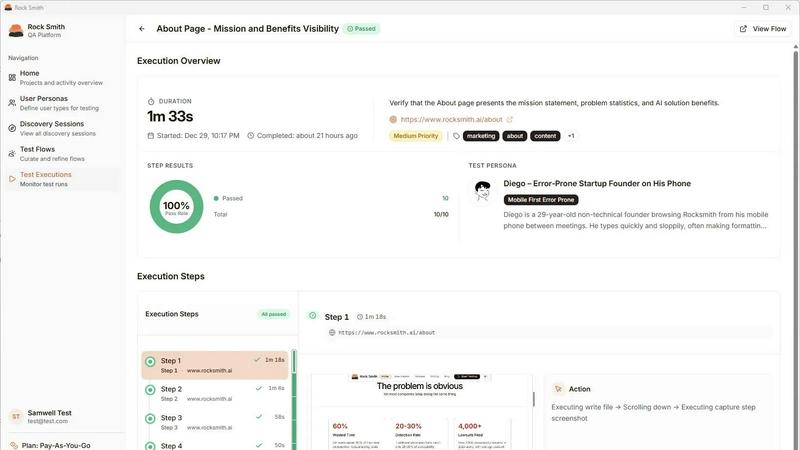
About Rock Smith
Rock Smith is the autonomous AI agent that revolutionizes black-box QA testing for modern web applications. Built for fast-moving engineering and product teams, it eliminates the tedious, brittle nature of traditional testing by deploying intelligent agents that mimic real user behavior. Its core innovation is semantic element targeting, which allows it to identify UI components based on their visual appearance and contextual meaning, not just fragile selectors. This means your test suite self-heals when the interface changes, drastically reducing maintenance and debugging time. For QA engineers, developers, and founders, Rock Smith delivers robust, adaptive testing that accelerates release cycles without compromising on quality or security. It’s not just another testing tool; it's an autonomous testing partner that lets your team focus on building what matters, ensuring you ship high-quality applications faster and with greater confidence.
Features of Rock Smith
Autonomous AI Testing Agents
Rock Smith deploys advanced AI agents that autonomously navigate and test your web application just like a human would. These agents execute complex user flows, click buttons, fill forms, and validate outcomes without the need for predefined, step-by-step scripts. This autonomy transforms testing from a manual, repetitive task into a hands-off, intelligent process that runs continuously and adapts on the fly.
Semantic Element Targeting & Self-Healing Tests
The platform's breakthrough semantic targeting engine identifies UI elements by what they are and what they do—like a "blue submit button" or a "login email field"—rather than brittle code selectors. When your design or layout changes, Rock Smith intelligently re-identifies the correct elements, allowing tests to self-heal. This feature slashes maintenance overhead and eliminates test flakiness caused by UI updates.
Built for Fast-Moving Teams
Rock Smith is engineered for velocity. It integrates seamlessly into agile workflows, providing immediate value to QA engineers, developers, and product teams. By automating the most tedious aspects of QA, it frees up your team to focus on innovation, complex problem-solving, and delivering features, enabling you to maintain a rapid development pace without sacrificing application stability.
Enhanced Security & Efficiency
Beyond functional testing, Rock Smith's autonomous agents proactively hunt for inconsistencies and potential security flaws during their interactions, offering an additional layer of scrutiny. By significantly reducing manual effort and accelerating test cycles, it delivers unparalleled efficiency, ensuring your application is not only robust but also secure before it reaches your users.
Use Cases of Rock Smith
Continuous Regression Testing for Agile Teams
For teams practicing continuous deployment, Rock Smith provides a relentless regression safety net. Its autonomous agents can be triggered with every code commit or build, executing a broad suite of tests to instantly catch regressions and UI breaks. This ensures new features don't accidentally break existing functionality, allowing for fearless iteration and faster shipping.
Reducing QA Maintenance Overhead
Eliminate the "test maintenance tax" that consumes QA resources. When developers refactor code or designers update the UI, traditional scripted tests break. Rock Smith’s self-healing capability means your QA team spends less time debugging and updating test scripts and more time on strategic testing initiatives and quality advocacy.
Rapid Feature Validation for Founders & Product Teams
Founders and product managers can use Rock Smith to quickly validate new user flows and feature prototypes before full development. By automating tests on live or staging environments, they gain immediate, reliable feedback on user experience and functionality, ensuring the product is built with purpose and solves real problems from the outset.
Supporting Lean Teams & Solopreneurs
For startups and solo developers without a dedicated QA department, Rock Smith acts as an automated QA engineer. It provides comprehensive testing coverage that would otherwise be impossible with limited bandwidth, ensuring a professional level of quality and reliability that helps small teams compete with larger, more resourced organizations.
Frequently Asked Questions
How does Rock Smith differ from traditional testing tools like Selenium?
Traditional tools like Selenium rely on static, code-based locators (like XPath or CSS selectors) that break with any minor UI change. Rock Smith uses AI and semantic understanding to target elements visually and contextually. This makes tests far more resilient and adaptive, turning a maintenance-heavy chore into an autonomous, self-healing process that requires minimal human intervention.
Who is Rock Smith designed for?
Rock Smith is built for anyone involved in building and shipping web applications efficiently. This includes QA engineers seeking automation, developers implementing CI/CD, product managers validating flows, and founders or solopreneurs who need robust testing without a dedicated QA team. It's for teams that value speed and quality equally.
Can Rock Smith integrate with our existing development workflow?
Absolutely. Rock Smith is designed to slot into modern development pipelines. It can be integrated into CI/CD platforms (like Jenkins, GitHub Actions, GitLab CI) to run tests automatically on every push or pull request. It also fits between design (Figma) and development (Cursor) phases, ensuring what is built matches the intended solution design.
What is semantic element targeting and how does it work?
Semantic element targeting is Rock Smith's method of identifying UI elements by their meaning and appearance rather than their underlying code structure. The AI analyzes the rendered page to understand components like "the primary call-to-action button" or "the navigation menu." This allows the system to find the correct element even if its HTML ID, class, or position changes, enabling truly self-healing tests.