
Serro AI
Serro AI keeps your human-agent team aligned by turning scattered tools into live program memory that drives coordination and action.
Visit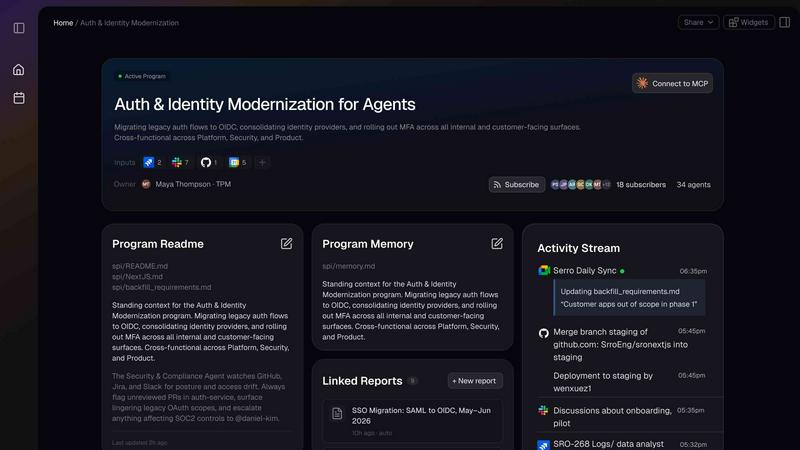
About Serro AI
Serro AI is the first Agentic Technical Program Management (TPM) infrastructure purpose-built for the modern engineering organization. In an era where AI has dramatically increased output, the bottleneck has shifted from writing software to coordinating it. Serro solves this by treating programs as first-class units of work, unlike traditional task trackers, roadmap tools, docs, dashboards, code-wikis, or generic project management platforms. It ingests scattered execution signals from Jira, GitHub, Linear, Slack, docs, meetings, and roadmaps, transforming them into trusted temporal program memory and real-time status coordination. This means every program gets a living brain that holds decisions, risks, owners, history, and activity automatically. Serro is built for technical program managers (TPMs), engineering managers (EMs), product managers (PMs), and engineering leaders who need to manage complex, cross-functional programs with human-agent teams. Its core value proposition is simple: Serro pays for itself on day one by eliminating coordination overhead, providing a shared operating system for human-agent organizations, and enabling teams to run more programs with less friction. Whether you are a startup scaling fast or an enterprise managing dozens of concurrent initiatives, Serro meets you where you already work through meetings, chat, and tool integrations.
Features of Serro AI
Program Memory
Program Memory is the live, always-current state of every active program in your organization. Serro continuously ingests signals from your connected tools like Slack, Linear, GitHub, Jira, Zoom, Notion, email, and codebase to automatically track decisions, risks, owners, dependencies, and historical activity. Instead of reconstructing context after meetings or digging through stale docs, you get a living record that updates in real time as work moves. This eliminates the need for manual status updates and ensures every stakeholder has an accurate, shared understanding of program reality.
Loops on Programs
Loops are automation-driven workflows that keep complex, cross-functional work moving without constant human intervention. Serro lets you define loops that automatically trigger status reports, escalate blockers, sync dependencies, and follow up on action items. These loops can run on a cadence (daily, weekly) or be event-driven based on changes in connected tools. For example, a loop can generate a daily summary for a payments migration, flag dependencies that are at risk, and notify the right owners. This turns coordination into a background process, freeing TPMs to focus on strategic decisions.
Agent Governance
Agent Governance is the control layer that ensures AI agents operate within defined boundaries while executing program tasks. As human-agent teams become the norm, Serro provides guardrails for agent behavior, including permissions, scopes, approval workflows, and audit trails. You can define what agents can read, write, or modify across programs, ensuring compliance and alignment with organizational policies. This feature is critical for enterprises scaling AI-driven execution, as it prevents drift, maintains accountability, and keeps human oversight in the loop without slowing down velocity.
Program Analytics
Program Analytics delivers a system-level view across your entire organization, turning fragmented updates into a live picture of program health. You can query any program, track velocity, identify bottlenecks, measure coordination gaps, and assess operational risk in real time. The analytics dashboard aggregates data from all connected tools and programs, providing leadership with actionable insights for faster decision-making. Instead of chasing status reports, executives get a clear view of momentum, blocker density, and team health. This feature scales from a single program to hundreds, making it indispensable for engineering leaders.
Use Cases of Serro AI
Technical Program Manager (TPM) Delegation
TPMs run multiple cross-functional programs simultaneously, but coordination overhead eats up their time. Serro allows TPMs to delegate status tracking, blocker escalation, and dependency management to AI agents. By connecting Slack, Jira, and GitHub, Serro automatically surfaces threads, generates daily summaries, and keeps timelines aligned. TPMs can query any program in natural language, get real-time updates, and turn meeting outcomes into tracked action items. This lets them scale their impact from a handful of programs to dozens without adding headcount.
Engineering Manager (EM) Reality Checking
EMs need to understand what is actually moving across teams without chasing updates. Serro gives EMs a shared view of work that cuts through noise. By ingesting signals from code commits, PRs, and issue trackers, Serro surfaces execution slippage, risk areas, and team health indicators. EMs can see where blockers are piling up, which dependencies are critical, and what needs attention next. This enables them to stay close to delivery without micromanaging, and to have data-driven conversations during one-on-ones and sprint reviews.
Product Manager (PM) Alignment
PMs constantly juggle roadmap shifts, decisions, and delivery progress across engineering and product teams. Serro connects these dots by maintaining a live record of decisions, ownership, and execution status. When priorities change, Serro automatically updates affected programs, notifies stakeholders, and tracks the impact on timelines. PMs can use Serro to ensure that product direction stays tied to execution reality, preventing misalignment and rework. This is especially valuable during fast-paced product launches where every decision has downstream consequences.
Engineering Leadership Oversight
Engineering leaders and executives need a real-time view of organizational health to make faster, better decisions. Serro aggregates data from all programs into a single analytics dashboard, showing momentum, blocker density, coordination gaps, and operational risk. Instead of relying on fragmented updates from multiple teams, leaders get a live picture of how the organization is performing. This enables them to identify systemic issues, reallocate resources, and intervene early on programs that are at risk. Serro turns coordination from a black box into a transparent, data-driven system.
Frequently Asked Questions
How does Serro differ from project management tools like Jira or Asana?
Serro is not a task tracker or project management platform. It is an Agentic TPM infrastructure that treats programs as first-class units of work. While Jira and Asana focus on tasks and tickets, Serro ingests signals from multiple tools (including Jira, GitHub, Linear, Slack, and docs) to build a living program memory. It handles coordination, status, decisions, risks, and dependencies automatically, without requiring manual updates. Serro works alongside your existing tools to provide a shared coordination layer for human-agent teams.
Can Serro work with my existing tool stack?
Yes. Serro is designed to meet you where you already work. It connects natively with Slack, Linear, GitHub, Jira, Zoom, Notion, email, and your codebase. Once connected, it starts ingesting signals immediately to surface the programs you are running. You can speak to Serro in meetings, message it in chat, and command it from your tools. There is no need to migrate data or change your workflow. Serro acts as a coordination layer on top of your existing stack.
How does Serro handle AI agent governance and security?
Serro includes a built-in Agent Governance layer that provides control over what AI agents can do within programs. You can define permissions, scopes, approval workflows, and audit trails to ensure agents operate within safe boundaries. All data is encrypted in transit and at rest, and Serro adheres to enterprise-grade security standards. For organizations with strict compliance requirements, Serro offers role-based access control and detailed activity logs. Human oversight remains central, with agents acting as assistants that follow predefined rules.
What is the difference between Serro Pro and Serro Lite?
Serro Pro is designed for enterprises that need to scale existing TPM capacity. It supports multiple TPMs, EMs, PMs, and engineering leaders collaborating on downstream program execution and agent loops. Serro Lite is built for earlier-stage companies that need AI-powered TPM capacity sooner. It gives smaller teams the ability to scale live coordination without a dedicated TPM function. Both versions include program memory, loops, agent governance, and analytics, but Pro offers advanced features for larger, more complex organizations.
Similar to Serro AI


Create, remix, and edit cinematic AI videos online from text, images, audio, and video prompts.


The fastest AI STL generator to turn prompts and images into 3D printable STL files.


AI tools somebody actually used before writing about them.

AI transcription for voice notes, meetings, and audio files in 1,700 languages, with AI summaries and subtitle export and unlimited chat ai usage.