Agenta vs diffray
Side-by-side comparison to help you choose the right product.

Agenta is an open-source LLMOps platform that centralizes prompt management, evaluation, and observability for AI teams.
Last updated: March 1, 2026

diffray
Unlock intelligent code reviews with diffray's AI, eliminating bugs and minimizing false positives for faster.
Last updated: February 28, 2026
Visual Comparison
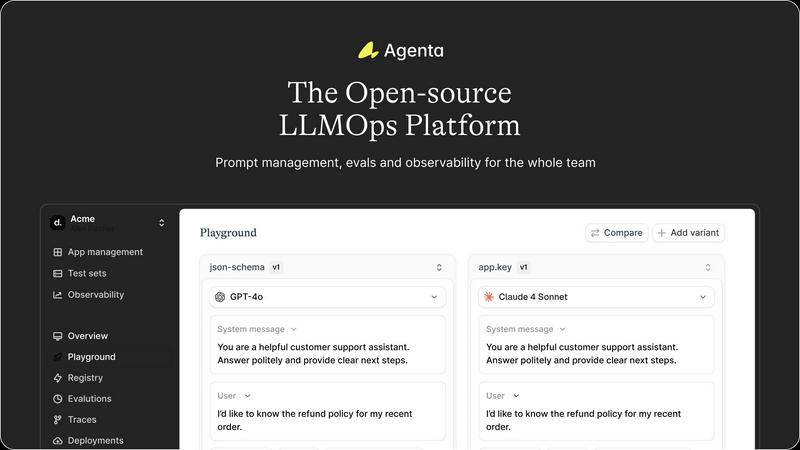
Agenta
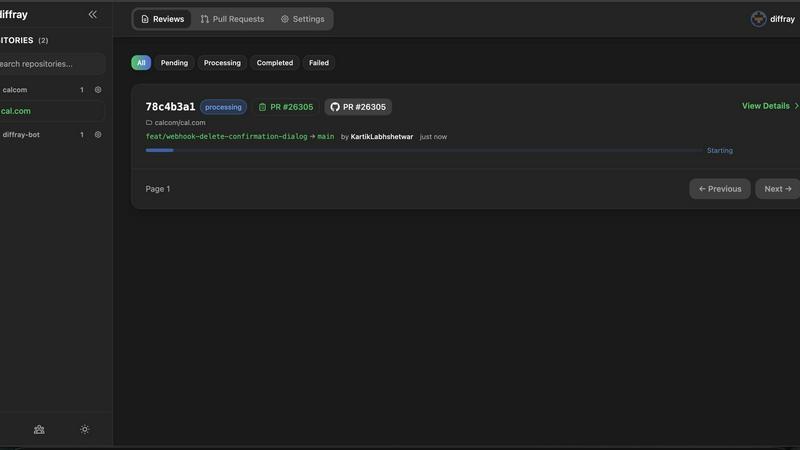
diffray
Feature Comparison
Agenta
Centralized Workspace
Agenta provides a unified platform to store all prompts, evaluations, and traces, eliminating the fragmentation of tools. This centralization fosters collaboration and ensures that everyone on the team has access to the same information, enhancing communication and efficiency.
Unified Playground
The platform features a comprehensive playground where teams can experiment and iterate on prompts side-by-side. With complete version history, users can track changes and compare different models, making it easier to identify the best-performing solutions without vendor lock-in.
Automated Evaluation
Agenta offers systematic automated evaluations that allow teams to run experiments, track results, and validate every change made. By integrating any evaluator, whether built-in or custom, it replaces guesswork with data-driven insights, ensuring informed decision-making.
Observability Tools
The observability features of Agenta enable teams to trace every request, pinpoint failure points, and annotate traces collaboratively. This functionality transforms feedback into actionable insights, allowing for quick debugging and continuous improvement of AI systems.
diffray
Multi-Agent Architecture
diffray's unique multi-agent architecture consists of over 30 specialized agents that focus on various code quality aspects. This ensures a comprehensive review process, catching potential issues without overwhelming developers with irrelevant feedback.
Accurate Issue Detection
With an astonishing 87% reduction in false positives, diffray ensures that developers can trust the feedback they receive. This accuracy leads to more efficient code reviews and allows teams to concentrate on genuine issues.
Rapid PR Review
By harnessing the power of diffray, organizations can reduce their PR review time from an average of 45 minutes to just 12 minutes per week. This remarkable efficiency allows development teams to maintain momentum and speed up their release cycles.
Enhanced Collaboration
diffray fosters collaboration among team members by providing clear and actionable feedback. This aids in aligning developers on best practices and encourages a culture of quality within the organization.
Use Cases
Agenta
Collaborative LLM Development
Agenta is ideal for teams working on LLM applications who need a structured way to collaborate. By centralizing prompt management and evaluation, teams can work together effectively, reducing miscommunication and enhancing productivity.
Iterative Prompt Testing
Teams can utilize Agenta to rapidly iterate on prompts in a controlled environment. With the unified playground, developers can test multiple variations and quickly identify which prompts yield the best results, accelerating the development cycle.
Performance Monitoring
Agenta allows teams to monitor production systems in real-time, helping to detect regressions and performance issues as they arise. This proactive monitoring ensures that any problems are addressed promptly, maintaining the quality of AI applications.
User Feedback Integration
By utilizing Agenta's trace annotation features, teams can gather valuable user feedback directly within the platform. This integration helps teams refine their models based on real-world usage, enhancing the overall effectiveness of their LLM applications.
diffray
Streamlining Code Reviews
For development teams facing bottlenecks during the code review process, diffray offers a solution that streamlines reviews, allowing teams to maintain productivity without sacrificing code quality.
Improving Security Posture
Organizations looking to enhance their security measures can leverage diffray's specialized agents that focus on identifying security vulnerabilities, ensuring that code is not only functional but also secure.
Boosting Code Quality
Teams striving to improve overall code quality can utilize diffray to receive targeted feedback on best practices, thereby fostering a culture of excellence and continuous improvement within their development processes.
Accelerating Development Cycles
In fast-paced environments, diffray empowers development teams to accelerate their release cycles by reducing the time spent on code reviews, enabling quicker iterations and faster time-to-market for new features.
Overview
About Agenta
Agenta is an innovative open-source LLMOps platform crafted to revolutionize the way AI teams build and deploy reliable large language model (LLM) applications. Designed specifically for developers and subject matter experts, Agenta streamlines collaboration across teams, addressing the chaos often associated with LLM projects. It centralizes the development process by integrating prompt management, evaluation, and observability into a single platform. The unpredictable nature of LLMs can scatter workflows and create silos among teams. Agenta breaks down these barriers, allowing for efficient experimentation with prompts, comprehensive evaluations, and effective debugging of production issues. By transforming scattered workflows into structured processes, Agenta enables teams to enhance performance, reduce guesswork in debugging, and accelerate the delivery of reliable AI applications. With Agenta, every team member can contribute effectively, ensuring best practices are followed throughout the LLM development lifecycle.
About diffray
diffray is a cutting-edge AI-driven code review tool that revolutionizes the traditional code review process. Unlike typical AI tools that depend on a singular model, diffray utilizes over 30 specialized agents, each meticulously tailored to examine critical aspects such as security, performance, bugs, best practices, and SEO. This innovative multi-agent architecture significantly reduces noise in pull requests (PRs), enabling development teams to focus on what truly matters. Users experience an impressive 87% reduction in false positives and a threefold increase in the identification of genuine issues. By implementing diffray, organizations can cut their PR review time from an average of 45 minutes to just 12 minutes per week. Suitable for teams of all sizes, diffray is designed to enhance code quality, promote collaboration, and accelerate development cycles, ensuring that projects remain robust, efficient, and high-performing.
Frequently Asked Questions
Agenta FAQ
What is LLMOps?
LLMOps refers to a set of practices and tools designed to optimize the development and deployment of large language models (LLMs). Agenta embodies LLMOps principles by providing a structured platform for collaboration, experimentation, and observability.
How does Agenta improve collaboration among team members?
Agenta centralizes workflows by integrating prompt management, evaluation, and observability into a single platform. This eliminates silos, allowing developers, product managers, and domain experts to work together more efficiently.
Can Agenta integrate with existing tools?
Yes, Agenta is designed to seamlessly integrate with various frameworks and models, including LangChain and OpenAI. This flexibility allows teams to incorporate Agenta into their existing tech stack without disruption.
Is Agenta suitable for both developers and non-technical users?
Absolutely. Agenta's user interface is designed to empower domain experts and product managers to run evaluations and experiment with prompts without needing to write code. This inclusivity enhances collaboration across diverse team members.
diffray FAQ
What makes diffray different from other code review tools?
diffray stands out due to its multi-agent architecture that employs over 30 specialized agents focusing on various aspects of code quality, ensuring comprehensive and precise feedback without the noise often found in traditional tools.
How does diffray reduce false positives?
By utilizing a diverse range of specialized agents, diffray enhances the accuracy of issue detection, leading to an impressive 87% reduction in false positives, allowing developers to focus on genuine problems in their code.
Can diffray integrate with existing development tools?
Yes, diffray is designed to seamlessly integrate with popular development tools and platforms, making it easy for teams to incorporate it into their existing workflows without disrupting their processes.
Is diffray suitable for teams of all sizes?
Absolutely! diffray is designed to enhance code quality and collaboration for organizations of all sizes, from small startups to large enterprises, providing valuable insights regardless of team scale.
Alternatives
Agenta Alternatives
Agenta is an open-source LLMOps platform designed to streamline the development of large language model applications. By empowering AI teams to manage prompt experiments, evaluations, and debugging processes, Agenta centralizes workflows that can otherwise become disorganized and inefficient. As users seek alternatives, they often do so for various reasons, including pricing, feature sets, and specific platform requirements that may not be fully met by Agenta. When searching for an alternative, it's crucial to consider factors such as ease of use, integration capabilities, and the specific needs of your team. Look for platforms that offer robust collaboration tools, automated evaluation systems, and comprehensive observability features to ensure a seamless transition and continued success in LLM development.
diffray Alternatives
diffray is an advanced AI-driven code review tool designed to streamline the code review process by utilizing a multi-agent architecture. It focuses on enhancing code quality and reducing false positives, making it a vital asset for development teams aiming for efficiency and collaboration. Users often seek alternatives for various reasons, including pricing, feature sets, or specific platform compatibility that may better align with their unique workflows and requirements. When searching for an alternative, it's essential to consider the tool's ability to integrate seamlessly with existing systems, its scalability for team growth, and the accuracy of its feedback to ensure it meets your development needs.