
HiAPI
HiAPI is the single unified API for leading AI image, video, and text generation models with persistent artifact storage.
Visit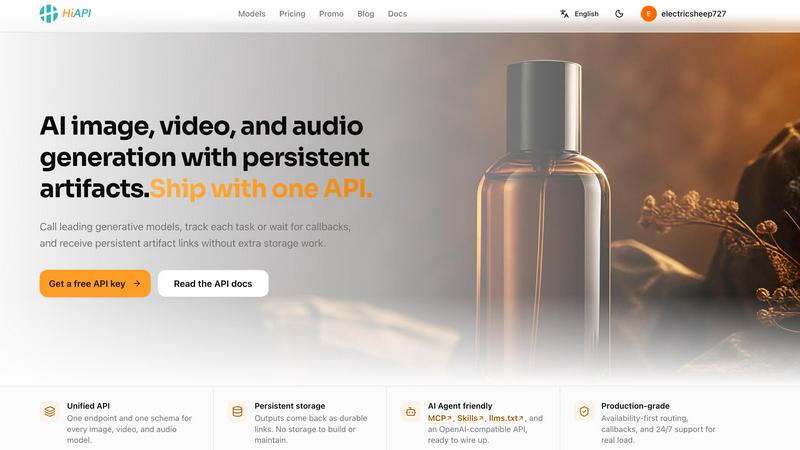
About HiAPI
HiAPI is a developer-first AI API platform engineered to streamline image, video, and audio generation by unifying access to multiple leading AI models under a single, coherent interface. At its core, HiAPI eliminates the friction of managing separate API keys, billing systems, and integration patterns for each generative model provider. Developers get one API key that works across a curated catalog of top-tier models, from OpenAI's GPT Image 2 and Google's Nano Banana 2 for image generation, to ByteDance's Seedance 2.0 for video and MiniMax Music 2.6 for audio creation. The platform is built for speed and reliability, offering OpenAI-compatible request formats so existing codebases require minimal changes to switch or combine models. Beyond simple API access, HiAPI introduces a task-based architecture where every generation job returns a persistent artifact link, removing the need for developers to build and maintain their own storage infrastructure. This is complemented by a unified billing system with pay-as-you-go pricing, meaning you only pay for what you use across any model. HiAPI is designed for two primary audiences: human developers who want to ship generative AI features quickly without vendor lock-in, and AI agents that need a programmatic, discoverable interface to compose complex workflows. The platform comes equipped with agent-friendly features like MCP (Model Context Protocol) tools, Skills for reusable agent instructions, and an llms.txt file that lets any agent instantly understand how to call HiAPI. Production-grade features like availability-first routing, callbacks for asynchronous workflows, and 24/7 support ensure the platform scales from prototype to enterprise load. Whether you are building a social media content generator, an automated design pipeline, or a music production tool, HiAPI provides the unified gateway to ship faster with less operational overhead.
Features of HiAPI
Unified API with One Endpoint
HiAPI collapses the complexity of multiple generative AI providers into a single POST endpoint at /v1/tasks. Instead of learning different API schemas, authentication methods, and billing models for each model, you pass the base model name and model-specific parameters through one consistent structure. This means your integration code stays clean and adaptable, letting you swap or add models by changing a string value rather than rewriting entire API calls. The unified schema validates parameters per request, ensuring you get clear errors if you pass invalid inputs for a specific model.
Persistent Artifact Storage
Every output generated through HiAPI comes back as a durable, persistent link. You do not need to build, configure, or pay for separate cloud storage to keep your images, videos, or audio files. When you set the storage parameter to "persistent" in your task request, HiAPI handles the hosting and delivery of the generated artifact. This eliminates a major operational headache for developers, especially those building media-heavy applications where managing file storage, CDN distribution, and access control can become a significant time sink.
Agent-Ready Integration Stack
HiAPI is built from the ground up for AI agent compatibility. It provides three distinct integration paths: Remote MCP tools for direct agent access, Skills for reusable agent instructions that standardize common workflows, and an llms.txt file that lets any agent discover and understand the entire API surface in seconds. This means agents like Claude, Cursor, and Codex can autonomously wire up to HiAPI, select the appropriate model, submit tasks, and retrieve results without human intervention. The platform publishes a ready-to-use prompt that developers can paste into their agent to enable this capability instantly.
Production-Grade Task Lifecycle
HiAPI implements a robust job-based architecture that supports both synchronous and asynchronous workflows. When you submit a task, you receive a unique task ID immediately. You can then poll for status or, more efficiently, set a callback URL to get notified on completion. The system supports idempotency keys, so retrying a submission does not create duplicate tasks, which is critical for payment flows and order processing. Route parameters allow you to specify beta or extended model versions, giving you control over which model variant to use without changing your core integration.
Use Cases of HiAPI
Automated Social Media Content Generation
Content teams can use HiAPI to generate images, videos, and music at scale for social media campaigns. With one API, you can call GPT Image 2 for sharp text-rendered thumbnails, Seedance 2.0 for cinematic video clips with native audio, and MiniMax Music 2.6 for background tracks, all within the same workflow. The persistent storage feature means every asset is immediately available via a link, ready to be posted or scheduled. The callback mechanism lets you trigger downstream actions like publishing or analytics as soon as each piece of content is ready, without manual polling.
AI-Powered Design Prototyping
Product designers and UI/UX teams can integrate HiAPI into their prototyping tools to generate visual assets on the fly. Use Seedream 5.0 Pro for text-to-image generation of UI mockups, then switch to GPT Image 2 for image-to-image editing to refine specific elements. The unified API means your design tool only needs one integration to access both capabilities. The pay-as-you-go pricing ensures you only pay for the generations you actually use during the prototyping phase, keeping costs low while iterating rapidly.
Music and Audio Production Pipelines
Music producers and app developers can build automated audio generation pipelines using HiAPI. MiniMax Music 2.6 can turn prompts and lyrics into complete songs with instrumental mode, while the task-based architecture allows you to submit multiple song requests in parallel and collect results via callbacks. The persistent artifact links mean generated audio files are immediately accessible for editing, mixing, or distribution. This is ideal for creating background music for videos, generating jingles, or powering interactive music features in games and apps.
Agent-Driven Creative Workflows
Developers building AI agents can use HiAPI as the creative backbone for autonomous content generation. An agent can read the llms.txt file, discover available models, and compose a multi-step workflow: generate an image with FLUX 1.1 Pro, then create a video from that image using Seedance 2.0, and finally add a soundtrack with MiniMax Music 2.6. The agent uses MCP tools to submit each task, checks status via the task API, and retrieves persistent links for the final output. This enables fully autonomous content creation pipelines for marketing, education, and entertainment.
Frequently Asked Questions
How do I get started with HiAPI?
Sign up at hiapi.ai to receive a free API key and up to one dollar in free credits to test the platform. You can immediately start making requests to the /v1/tasks endpoint using the provided API key. The platform supports curl, JavaScript, and Python examples in the documentation, and you can use the same key across all supported models. No credit card is required for the initial trial credits.
What models are currently available on HiAPI?
HiAPI supports a curated selection of leading generative models. For image generation and editing, you have access to GPT Image 2, Nano Banana 2, FLUX 1.1 Pro, and Seedream 5.0 Pro. For video, Seedance 2.0 from ByteDance is available with cinematic quality and multi-shot consistency. For audio, MiniMax Music 2.6 can generate complete songs from prompts and lyrics. The platform regularly adds new models, and you can check the Models page for the latest additions and pricing.
How does the persistent storage feature work?
When you submit a task, you can set the storage parameter to "persistent" in your request body. HiAPI will store the generated output and return a durable URL in the task response. These links remain accessible for retrieval and do not require you to set up your own cloud storage or CDN. This is included in the per-task pricing, so there are no additional storage fees beyond the generation cost.
Can I use HiAPI with AI agents like Claude or Cursor?
Yes, HiAPI is designed for agent compatibility. You can use the Remote MCP tools for direct agent access, or paste the llms.txt prompt into your agent so it understands the full API surface. The platform also provides reusable Skills that standardize common workflows for agents. This makes it straightforward for agents to discover models, submit tasks, and retrieve results autonomously.
Similar to HiAPI

ImageGPT is an all-in-one AI creative platform for generating, editing and transforming images and videos using AI.

Create release-ready album covers from a prompt or photo. Generate, refine, and export art for singles, EPs, mixtapes, and playlists.

A free browser-based toolkit for creating, cutting, converting, and previewing sprite sheet animations.

AI tattoo generator for turning ideas, photos & sketches into expressive designs.

Explore Flux LoRA workflows online with a focused AI Studio, model discovery roadmap, and guided training plans.

Turn any image into editable transparent PNG layers with AI.

Generate from a text prompt, at 1K or 2K, change the scene. Keep the subject

The fastest AI STL generator to turn prompts and images into 3D printable STL files.